
Shoal Beacon, Gulf of Bothnia. 2023
FOUR SHORES
An Edge Cartography of Temporal Worlds
Four Shores is a long-form exploration of movement, estrangement, memory, and return.
Moving between photography, film, writing, archive, and conversation, the project traces the edges between exile and belonging, departure and return, memory and place.
Built across decades spent between Britain, Africa, Asia, and the northern world, Four Shores gathers fragments, atmospheres, and observations from lives shaped by outward trajectories, unstable belonging, and difficult homecoming.

Lost in translation. A loud dream, carefully maintained in a quiet country. On the road to Uusikaupunki, Finland. 2023
THE ONTOLOGY OF DRIFT
1963
Bradford, England
1975 – 1983
Johannesburg, South Africa
1984
London
1985
Johannesburg
1986-1988
London
1989 – 1997
Hong Kong
1997 – 1999
Johannesburg
2000
New York
2001 – 2003
Cape Town, South Africa
2004
Paris
2005
Cape Town
2006
Bangkok / Seoul
2007-2008
Cape Town
2009-2016
Saigon, Vietnam
2017
Phuket
2018-2022
Penang, Malaysia
2023
Saigon
2024
Taipei, Taiwan
2025-2026
Penang, Malaysia
2027
Lithuania, England, Scandinavia
FOUR SHORES

West
Withdrawal & Return
BRITAIN
— the homeland as foreign
—a reckoning with origin

Paradise Street. Bradford. Google Maps Street View. 2021

South
Wonderment & Conflict
SOUTHERN AFRICA
— the world opening, wide-eyed
—an education in distance and not fully belonging

Seapoint, Cape Town, South Africa. 2024

East
Exuberance & Drift
SOUTH EAST ASIA- HONG KONG
— the world as spectacle
— freedom and abandon

Kowloon Bay, Hong Kong , China. 2019

North
Silence & Return
SCANDINAVIA
—the primordial shore
—the home northward

A mythical Norse landscape. Nesna. Arctic Circle, Northern Norway. 2023
Methodology
Four Shores unfolds through continual movement — across continents, coastlines, and former maritime routes — as a deeply personal long-form exploration of exile, belonging, and return.
While rooted in lived experience, the project also examines the lives of others shaped by movement, displacement, and the existential conditions that emerge from prolonged outward journeys.
Bringing together photography, film, writing, interviews, and archival fragments, the work explores what continual movement does to identity over the course of a lifetime.
Drawing influence from explorers, observers, writers such as James Cook, Joseph Conrad, Paul Theroux and Barry Lopez, Four Shores approaches wandering not as adventure mythology, but as a lasting condition of consciousness — where movement becomes both liberation and estrangement, and return increasingly uncertain.
The four regions — Britain, Africa, Asia, and the Northern Europe — function not simply as geographies, but as psychological worlds shaped by memory, history, atmosphere, and personal experience. Together they form a broader maritime arc tracing outward expansion, observation, ageing, displacement, and the complicated idea of home.
Rooted in observation rather than explanation, the work is drawn toward port cities, coastal towns, trading entrepôts, landscapes and places carrying historical residue. People appear within these environments not as isolated subjects, but as fellow inhabitants moving through larger currents of time, culture, memory, and transition.
Rather than constructing a fixed narrative, Four Shores operates as an evolving edge cartography of temporal worlds — mapping the emotional and existential terrain between departure and return.

Ruminations of a Baltic kind. Aboard the Karlshamn to Klaipeda ferry. 2024
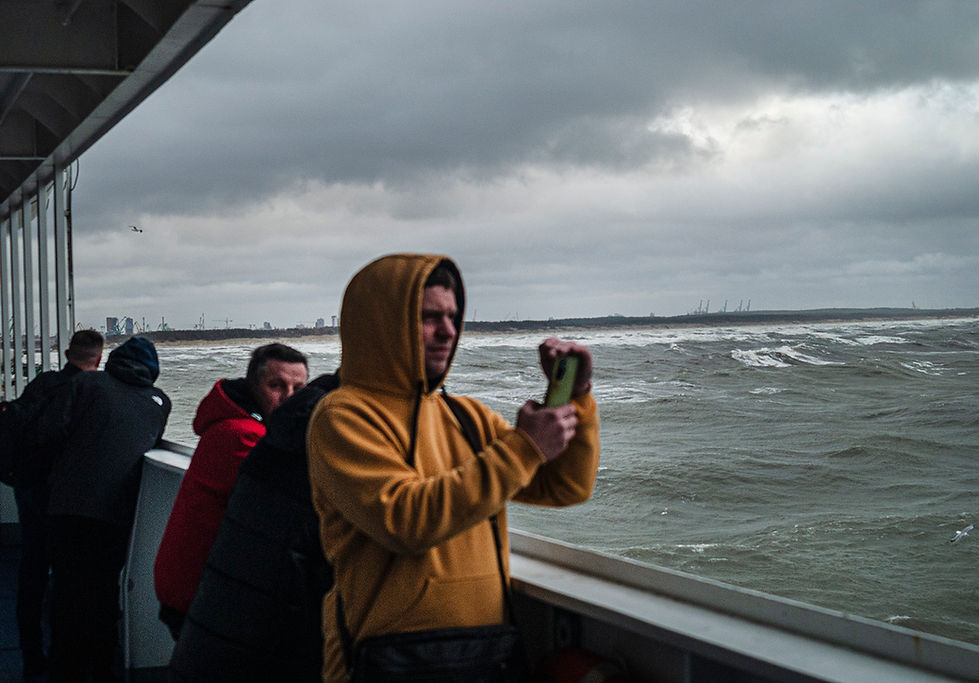
Movement alters the architecture of consciousness.
Place, distance, and memory become psychological conditions.
The landscape is no longer backdrop, but inward terrain.

Curonian Gulf. The Baltic Sea. Lithuania. 2024
Intent
This is not a documentary of my world. It is an attempt to render;
-
what it means to wander
-
the emotional aftermath of movement
-
the unstable geography of belonging
-
how distance, history, imagination, and literature shape perception
-
the edges between exile and return
-
the psychological weight of memory, drift, and ageing
-
how landscapes become inward terrain
The work does not ask to be consumed.
It asks to be felt.
To be considered.
To be reflected upon.

Conradian Dreams. Mount Kelud, East Java, Indonesia 2025

The Archive of Movement
What began as movement slowly became condition.
Over decades, repeated crossings accumulated into a kind of modern maritime logbook — air corridors replacing sea routes, transit becoming habitat.
Not tourism.
Orbit.
The archive traces a life lived through airports, tropical and temperate climates, post-colonial worlds, hotel rooms, island states, ports, thresholds, and continual departures.
And after enough years, movement ceases to feel temporary.
It becomes psychological.
Like the sailors, explorers, correspondents, and wanderers of earlier eras, prolonged absence from homeland produces its own inward condition — observational, detached, restless, melancholic.
The returning wanderer often discovers that home itself has become unfamiliar.
One may physically return, but psychologically remain offshore.
The Orbit
(archive of movement)
Scroll Flights from 1975- 2026
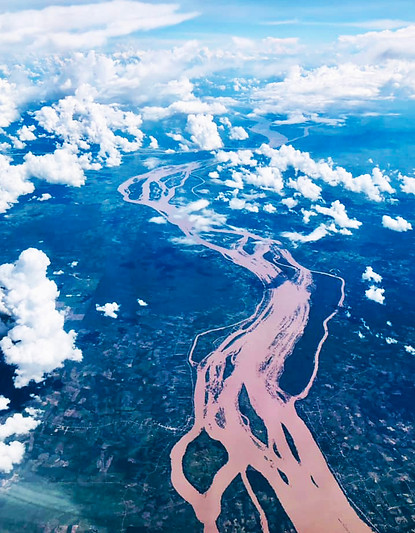
38,000 ft over the Mekong Delta.
Flight # 613. Bangkok- Manila. Cebu Pacific. A320-200. 2024

International Hotel. Port Penang. Malaysia 2020.

Position
Where traditional documentary often seeks explanation, and much contemporary work seeks interpretation,
Four Shores operates in another register:
the photograph, the fragment, the interview, the journey as sites of quiet recognition.
Not a cartography of centre, certainty, or fixed belonging, but between —
land and sea
exile and belonging
movement and stillness
memory and present reality
civilization and wilderness
observation and participation
the external world and the internal one
ageing and unfinished identity
the idea of home and its disappearance
a life once imagined and a life ultimately lived
The work emerges from prolonged outward movement across continents, coastlines, former maritime routes, and psychological thresholds.
Over time, displacement ceases to be geographical.
It becomes existential.
The landscapes within Four Shores are therefore never simply locations.
They become states of mind.
Temporal worlds.
Emotional weather systems.
Fragments gathered from lives lived partially offshore.
This is where the work exists.
At the edge.

Gulf of Bothnia. 2023

Table Mountain, Cape Town City Bowl, Atlantic Seaboard
Kelp Gull, Fish Hoek, Indian Seaboard
South Africa 2006

He who witnessed the end of an era. Victoria Harbour. Hong Kong 2018

Interviews / Pathfinders
Four Shores extends into a parallel strand of filmed interviews and photographic portraiture under the working series Pathfinders.
These encounters move beyond documentation. They are attempts to listen for lived patterns of displacement, adaptation, endurance, fracture, and difficult belonging in the lives of others.
The conversations unfold slowly, often through memory, atmosphere, digression, and reflection rather than formal testimony alone.

Old Asia Hand. Veteran photographer, publisher, writer, China and Afghanistan aficionado, Magnus Bartlett pictured at his
home, Lamma Island. Hong Kong 2022
Influenced by figures such as Cook, Conrad, Lopez, Chatwin, and Theroux, the project draws upon traditions of outward travel, observation, and psychological drift — not as historical reference points, but as enduring frameworks for understanding lives shaped by prolonged distance from any fixed centre.
In this sense, Four Shores is not only a personal cartography, but also a search for others who inhabit similar conditions: individuals whose lives have unfolded across outposts, borderlands, coastal settlements, remote geographies, and unstable ideas of home. Many are people whose trajectories outward never fully resolved into return.

Pathfinders-episode 1. Recorded at Johannesburg Country Park & Camp, South Africa 2024.

Gwen Rea. Pathfinder #1. Pictured at the Johannesburg Country Park & Camp, South Africa 2024.
The interviews focus on what might be described as Conradian lives — shaped by distance, adaptation, moral ambiguity, solitude, and the quiet residue of time spent away. These are not heroic narratives of exploration, but quieter and more ambiguous accounts of continuity, estrangement, endurance, compromise, and ageing across shifting worlds.
What emerges is a growing archive of voices and faces connected less by geography than by a shared psychological condition: lives lived along the edges, where identity remains in continual negotiation between memory, movement, and place.

The Memory Vault
The Memory Vault is not just a storage room, a shrine to nostalgia, or a place to wallow in the past.
It is a practice. A communion, not with what was, but with how things were.
There, fragments of a life are gathered: books, prints, negatives, journals, objects. Each carries the weight of time—of decisions made, of moments moved through, of things observed, and of places and people left behind. But their value is not only in possession but in what they reveal: about travel, curiosity, and the process of living outwardly.
Treasured trinkets get pared down to essentials. Itinerant travelers scatter things about. You cannot fill a home with things if you never fully have one. The Vault is where the analogue world meets the restless impulse to move beyond it. Where weight and texture, paper and film, are held briefly to the light before release.
The Memory Vault teaches the following:
-
That escape is not running away but breaking out
-
That freedom is not the absence of ties, but their conscious shaping
-
That art and life are inseparable—each fragment a way of thinking about how to live
-
That letting go is as necessary as collecting
The Memory Vault is not private. It is reflective.
For within its shelves lies not a single life, but a pattern of lives: shaped by choice, obsession, departure, and return.
To encounter the vault is to find evidence of one life layered into others. Not meshed. Not complete. But attended to.
The Memory Vault is not the end, but another beginning, where a process of excavation and release continues.
It asks the question: what is worth keeping? What must be discarded? What has value beyond life itself?
Personal and cherished books, handwritten letters and journals, records, cassettes, photographs, films—these are not just things. They are fragments of life that define a person, a life, an attitude, a style, a passion. What remains if all of this is discarded?
The Memory Vault is a memory incubator. It contains artifacts of mass, shape, and volume that release something weightless and formless—yet capable of carrying more emotional weight than the material world that produced them.

The Memory Vault - intro video
Nostalgia

Antiquity in the modern age. What's left of it? Hoi An, Vietnam. 2013
Nostalgia runs deeply through Four Shores — not as sentimentality or retreat, but as a persistent awareness of worlds, atmospheres, and ways of living that now feel increasingly out of reach.
Much of the work emerges from a tension between the contemporary world and an enduring attraction toward older ideas of movement, distance, mystery, and lived experience.
I remain drawn toward the analogue world. This is not a claim that the past was better. Often it was not. But it carried different textures of lived reality, longer silences, and a different relationship to time, attention, and the unknown.
Nostalgia within Four Shores therefore functions less as longing for a lost golden age, and more as an attempt to understand why certain vanished worlds continue to exert such emotional force upon the present.
It reflects an ongoing negotiation between memory and modernity, between movement and return, and between the desire to remain open to the contemporary world while still mourning the disappearance of so much.


